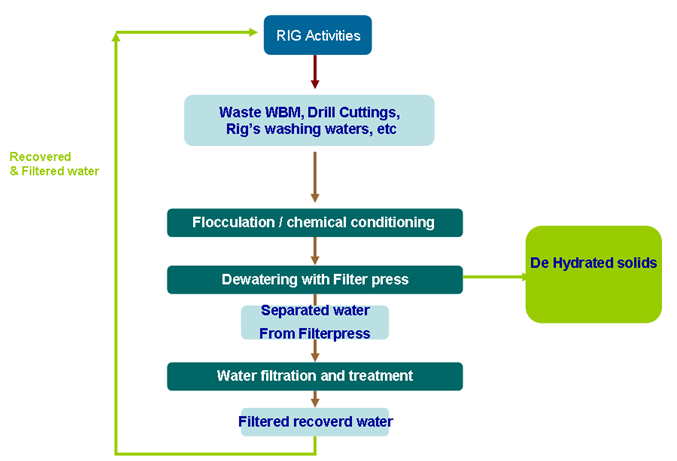
Exhaust drilling mud dehydration is a process that allows the reduction of the total volume of waste to be disposed of at a rig site. In fact, the treatment allows the separation of the solid fraction from the water, which can be re-used at the mud preparation installation.
For the rig site waste management, it is very important the reduction of the total amount of substances to be disposed of, both for cost savings and to reduce the impact on the environment.
The treatment process, based on chemical conditioning and mechanical dehydration, allows the drilling mud to be reduced in volume around 35-40% up to 60% of the original, depending on the % in solids of the incoming mud.
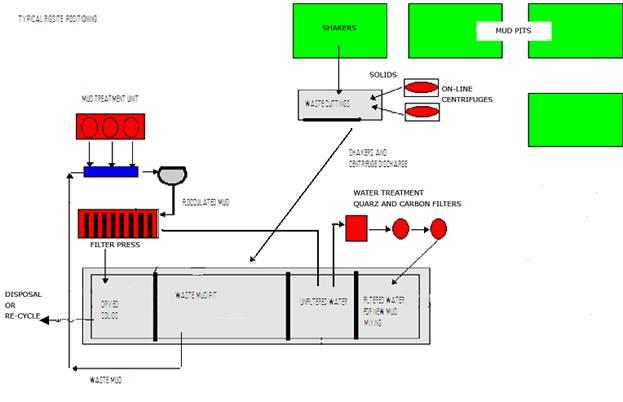
The water, processed through the filter-pressis then pumped to another unit composed by a quartzite and activated carbon filters, which allow the reduction of suspended solids and refines the quality of outgoing water. Usually the treated water is directly recycled to the mud plant, mixed with fresh water in % to be decided by the mud engineer.
The solid fraction is very dry (about 4% of water) and in all the Countries we are currently working at, can be disposed in a non-dangerous waste landfill.
The following sections describe the dehydration process more in detail.
The drilling mud to be processed, once arrived at the plant location, has to be stored in dedicated impermeable basins, in which, depending on the type of incoming material, it will be possible to separate oil (if present) from the mud prior to proceed with the dewatering phase.
The mud is then pumped to the chemical treatment unit, in which suitable flocculants are added in order to destabilize the suspension and facilitate the dehydration through a filter-pressing process.
The dosing of chemicals is properly optimized in order to destabilize the suspension, to precipitate micro-pollutants, such as insoluble salts, and to flocculante the solids to improve their separation from the liquid phase.
Water obtained through the filtration process is sent to another section of the plant for the final elimination of the residual flocculants.
Depending on the content of oil in the drilling mud, another oil/water separation section might be needed.
The above chemical and mechanical treatments will generate the following products:
The oil (if present) is separated with a skimmer and stored in pits to be recovered; the drilling exhaust muds are pumped to the chemical treatment unit where the chemical agents are added as previously indicated.
The sludge is then fed from the chemical treatment unit to the filter press; once the fluids are processed in the filter press, the cake will be stored for maturation and disposal, and the water will be pumped to a separate filtering unit, in order to separate the oil extracted from the solid fraction (if present).
The water coming from the filter-pressing process will be pumped to a carbon and quartzite filters (filtering unit) which will clean out any residual organic and inorganic polymers.